The AI Control System
The control cannot be the human standing behind AI. It has to be the environment surrounding it - and here is what that environment is made of.
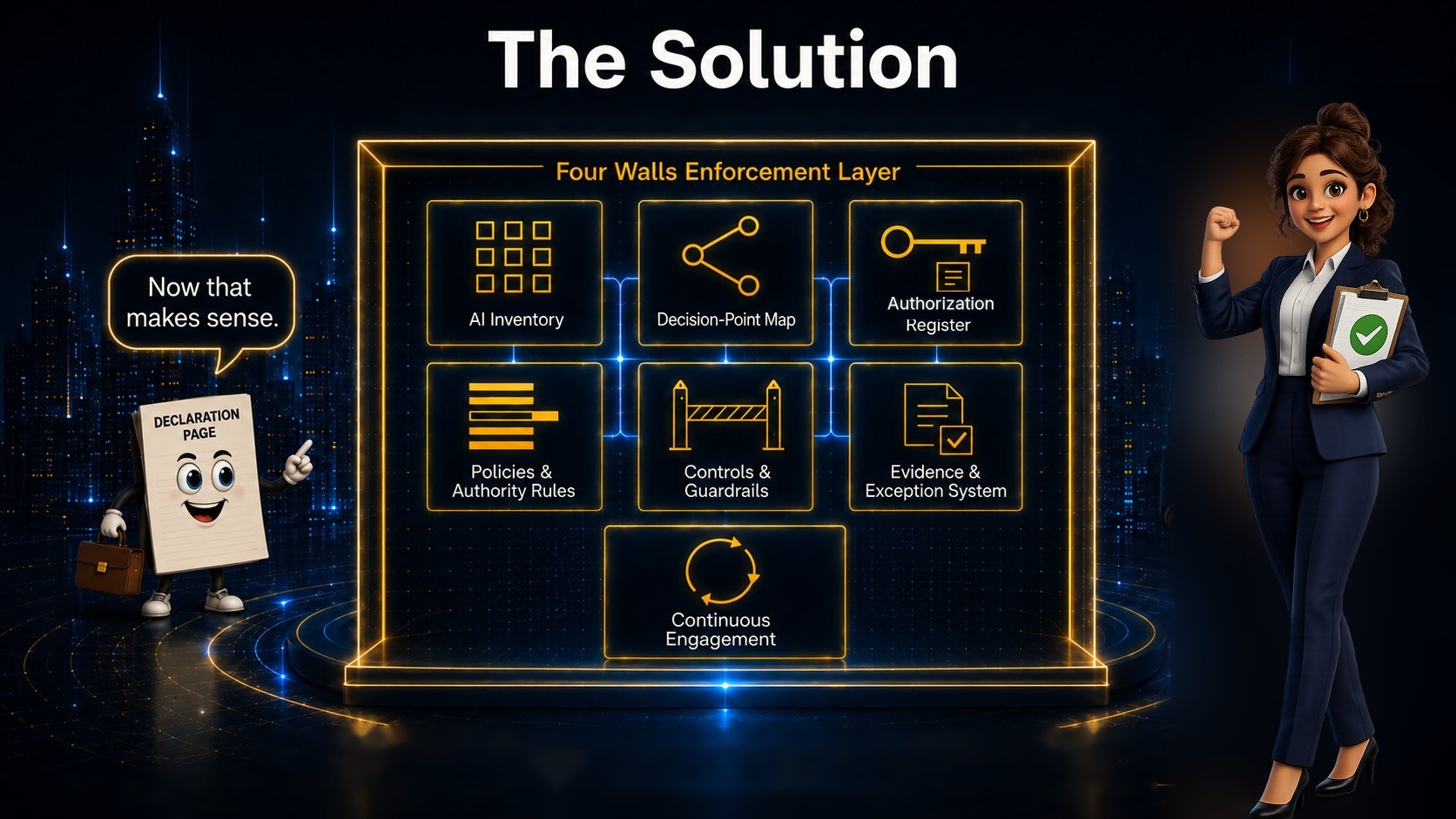
Seven Components create the system. The Four Walls environment enforces it.
The components
Seven components to derisk AI, plus an enforcement layer
Each one an artifact you can hold, hand to an underwriter, or produce in response to a question.
Inventory
AI Inventory
Every place AI operates - embedded features, vendor and carrier assistants, adopted tools, and shadow use on personal accounts.
Decisions
Decision-Point Map
Every point where AI selects, interprets, classifies, recommends, communicates, records or initiates. This does not exist in standard guidance.
Authorization
Authorization Register
Tool, version, account type, users, use cases, permitted data, vendor screening, named owner, review cycle and status.
Policies
Policies & Authority Rules
The rules, the operating procedures that carry them out, and the authority matrix defining who may decide what.
Guardrails
Controls & Guardrails
Risk-based review thresholds, workflow gates, verification points, escalation routing and completion evidence.
Evidence
Evidence & Exception System
Incident log, exception routing, dashboards, measurement. Exception-only by design.
Engagement
Continuous Engagement
Advisory, training that changes daily behavior, periodic re-authorization, incident response, and the learning loop.
Plus an enforcement layer
The double perimeter
The seven components sit inside an enforced boundary. See how it works →
Business leaders are often advised to ask vendors: “How are you using AI safely?”
The question that matters is: Can you identify every point where AI can make or influence a judgment - and the control that prevents it from deciding on its own? If the vendor cannot answer, that is not merely a red flag. It is an evacuation alarm.
The enforcement layer
The double perimeter
Think of a smart home: security, HVAC, appliances, entertainment, sprinklers, pool all on one control system. Now put it inside a facility built to control what enters and what leaves.
That’s The Enforcement Layer - what makes them one - and what makes the rules hold even when nobody is watching.
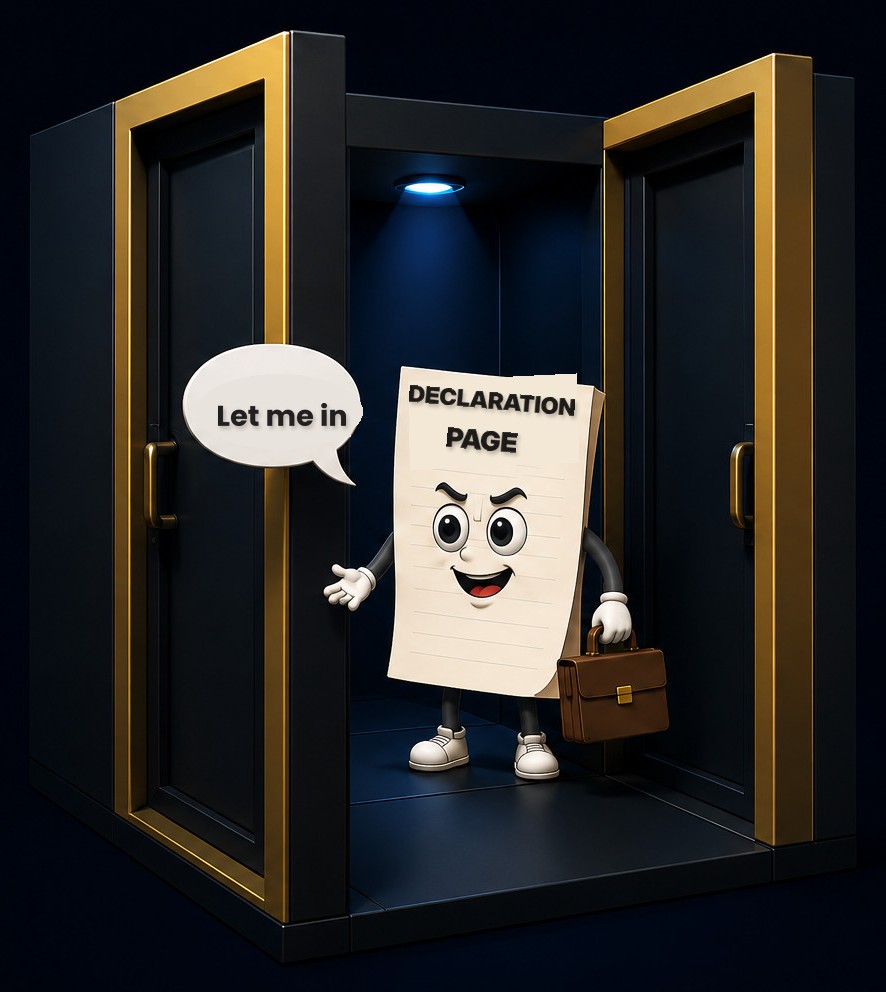
Define
Humans define
The rules, authority levels, thresholds and acceptable risk. Business judgments that stay with accountable people.
Enforce
Technology enforces
The boundary holds without anyone policing it, and exceptions surface on their own rather than waiting to be discovered.
Resolve
Humans resolve
The consequential decisions and the exceptions, with the accountability that goes with them. This never transfers to the tool.
Inside-Out and Outside-In, example of an Insurance Agency.
Scroll to see the full diagram
Inside-Out - what leaves
Client data pasted into a public model. Procedures shared externally. The response builds the approved path into the environment, so nobody has to choose between serving the client and following an impractical rule.
Outside-In - what enters
An AI-generated explanation that lands in a client file becomes part of your record. The response is an approved intake route, screening, and separate handling for personal-device traffic.
How to start
What working with us actually looks like
Each step is a decision point, not a commitment to the next one.
Schedule
01 · Complimentary Pre-Assessment
Schedule it, get the results. No written assessment, no recommendations, no obligation, no cost.
Assess
02 · AI Risk & Controls Assessment
Current-state review, the initial inventory and decision-point map, exposure and gap analysis.
Build
03 · Managed Engagement
Build and launch the operating rules, controls, training, documentation and rollout path.
Continue
04 · Continuous Engagement
Monthly advisory, review, updates, exception guidance and control refreshers.
Four Walls
05 · Four Walls Implementation
Required technical containment, enforcement and maintenance. (Option: may be installed by AI GuardWorks or other integrator)
This is what gets built
AI is here. The risk is real. Control is possible.
A structured conversation about where AI already operates in your business and where control is missing. No written assessment, no obligation, no cost.
Complimentary Pre-Assessment What certification requires →